FN
5.0Reviewed Feb 19, 2020
I only have basic accelerator background and the course have helped me improve my understanding of accelerator technology

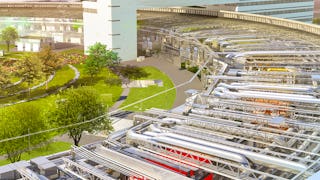
Did you know that particle accelerators play an important role in many functions of todays society and that there are over 30 000 accelerators in operation worldwide? A few examples are accelerators for radiotherapy which are the largest application of accelerators, altogether with more than 11000 accelerators worldwide. These accelerators range from very compact electron linear accelerators with a length of only about 1 m to large carbon ion synchrotrons with a circumference of more than 50 m and a huge rotating carbon ion gantry with a weight of 600 tons! There are also a growing number of synchrotron light sources in the world. The light in these sources are created by electrons that are accelerated to almost the speed of light. This light can reveal the molecular structures of materials and also take x-ray pictures of the inner structure of objects. Synchrotron light sources are very important in life sciences, material sciences and chemistry. Another type of accelerators are used in spallation sources, like the European Spallation Source in Lund, Sweden. Here protons are accelerated to very large energies. They produce neutrons when they are smashed into a disc of tungsten. These neutrons are used for finding the inner structure of objects and atomic structures of materials. Finally there are many accelerators for basic physics, like the large hadron collider in Cern. This course takes you on a journey through the technologies used in particle accelerators: The microwave system which produce the electromagnetic waves that accelerate particles; The magnet technology for the magnets that guide and focus the beam of particles; The monitoring systems that determine the quality of the beam of particles; Finally the vacuum systems that create ultra high vacuum so that the accelerated particles do not collide with molecules and atoms. Exciting right! The course is graded through quizzes, one for each of the four modules. Throughout the course there are also a number of training quizzes to offer you support. The four modules in the course are: RF-systems, Magnet technology, Beam diagnostics, and Vacuum techniques. In total there are 48 lectures, where each lecture is a 2-4 minutes long video presentation. Some of the lectures are followed by short texts with complementary information and all will hopefully be an exciting collection for you to engage with. Have fun!
FN
I only have basic accelerator background and the course have helped me improve my understanding of accelerator technology
RM
Description of complex devices in particle accelerator field are explained in very lucid way.
RM
Some of the English could be clearer, but the information and delivery is generally great!
VK
Great Course, Thank you NPAP! Would you please be kind and review/check the answers in week 3 graded test and compare it with answers in quizes? specially questions numbers 21, 19, and 25?
CS
Very informative course and touch many technical sectors. The content is Week 3 is the most challenging.And some of the English subtitles interpreted incorrectly.
CL
Excellent course, thank you so much. I am about to start a thesis at former IPNO in Orsay, and sure those knowledge will be of use.
HR
This course offers a great introdution to particle accelerators and is suitable to almost everyone!!
NM
This course is really good and interesting to about particle accelerator.
Showing: 20 of 22
I do not recommend this course if you're intending to learn any deep concepts.
1) The course instructors look like they don't want to be there, and are basically present to read from a script. The slides are next to useless because they barely help illustrate anything the instructors say. Week 4 on vacuum technologies is the worst: I could barely make out many important terms. Even the transcripts describe many words/phrases as "unintelligible" and no one from the course team has decided to fix the transcripts to at least help with how incomprehensible things already are.
2) Much of the content is shallow, so you learn a bunch of names/terms but there is no attempt to help you understand concepts or principles. Most of the videos have no link to one another, and they don't even try and show you how the things they mention fit in together on a whole. A very simple thing to do would have been to provide a summary with a quick comparison at the end of each section of all the objects/technology that have been touched upon.
3) Answering quiz questions will involve a bunch of guess work because videos are mainly terrible at describing and explaining.
Very good course. I have taken the NPAS course in Lund in 2015 and used this course as a refresher. The instructors are very good and experts on their respective fields. One does not require advanced bed knowledge on Physics or Engineering to follow the course. A must for everyone working around particle accelerators but don't necessarily work with particle accelerator physics.
This course offers a great introdution to particle accelerators and is suitable to almost everyone!!
Great Course, Thank you NPAP!
Would you please be kind and review/check the answers in week 3 graded test and compare it with answers in quizes? specially questions numbers 21, 19, and 25?
I only have basic accelerator background and the course have helped me improve my understanding of accelerator technology
Very interesting course !
Short videos with clear explanations and good pictures/illustrations
Description of complex devices in particle accelerator field are explained in very lucid way.
This course is really good and interesting to about particle accelerator.
This course covers a lot of knowledge about accelerator technology.
Great instructors and content
Excellent, thank you.
bueno
I am a vacuum scientist at a light source and I used this course to fill gaps in my knowledge. For instance, the RF and magnet sections were very helpful because I do not interact with these systems often and I have not had to learn much about them thus far.
However, I noticed some gaps between quiz questions and the videos and there were small inaccuracies in the information given. For instance, the vacuum instructor called a Pirani gauge a cold cathode gauge after discussing Pirani gauges under the umbrella of thermal gauges. To give another example, the question pertaining to beam coordinates gave five parameters rather than the needed si (probably just a typographic error). I did not find any gaps or inconsistencies stifling but someone with less experience in the field might.
Is there any possibility of more advanced in-depth modules? It would be very nice to have, say, five weeks on RF systems.
The content is instructive. I recommend this course for all users of accelerators who want to know the basics of the facilities they are using. If we can have improvements in a few points, it would be better even more.
Typos: There are a lot of typos in the subtitles and quizzes.
Additional explanations: Week 4 would be better if it contains reading materials on the additional details.
The course was very interesting and engaging. Some of the parts were like just exhibits of accelerator components, more explanation could be added. Such courses are really difficult to find. Thanks to the instructors and team.
Nice and interesting course. Clear explaination.
In my opinion, it would be very useful to have a written summary of the lessons, in pdf, as a reference or a review.
Excellent course, thank you so much. I am about to start a thesis at former IPNO in Orsay, and sure those knowledge will be of use.
Some of the English could be clearer, but the information and delivery is generally great!
Interesting course to understand the way particle accelerators work.
Very informative course and touch many technical sectors. The content is Week 3 is the most challenging.
And some of the English subtitles interpreted incorrectly.