Biology Courses
Biology courses can help you learn cellular processes, genetics, ecology, and evolutionary theory. You can build skills in laboratory techniques, data analysis, and critical thinking through hands-on experiments and field studies. Many courses introduce tools like microscopes, DNA sequencers, and statistical software, that support conducting research and analyzing biological data.
Popular Biology Courses and Certifications
 Status: Free Trial
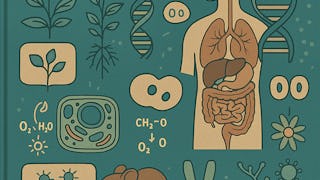
Rice University
Skills you'll gain: Biology, Environment, Microbiology, Life Sciences, Environmental Science, Molecular, Cellular, and Microbiology, Environmental Issue, Environment and Resource Management, Infectious Diseases, Demography, Sustainable Development, Natural Resource Management, Molecular Biology, Cell Biology, Anatomy, Estimation, Taxonomy, Scientific Methods, Experimentation, Case Studies
Birla Institute of Technology & Science, Pilani
Skills you'll gain: Scientific Methods, Physiology, Biotechnology, Biology, Life Sciences, Laboratory Research, Cell Biology, Immunology, Molecular, Cellular, and Microbiology, Anatomy, Molecular Biology, Science and Research, General Science and Research, Biochemistry, Respiration, Endocrinology, Oncology
 Status: Free Trial
Johns Hopkins University
Skills you'll gain: Oncology, Medical Imaging, Radiology, Diagnostic Radiology, Patient Education and Support, Mammography, Radiation Therapy, Molecular Biology, Diagnostic Tests, X-Ray Computed Tomography, Clinical Trials, Molecular, Cellular, and Microbiology, Capillary, Pain Management, Preventative Care, Treatment Planning, Hemodynamics, Drug Development, Cell Biology, Biology
 Status: Free Trial
Lecturio
Skills you'll gain: Molecular Biology, Biochemistry, Cell Biology, Molecular, Cellular, and Microbiology, Life Sciences, Pharmacology, Biology
 Status: Preview
Duke University
Skills you'll gain: Physiology, Pulmonology, Respiration, Anatomy, Endocrinology, Cardiology, Human Musculoskeletal System, Nephrology, Hemodynamics, Biology, Vital Signs, Electrophysiology, Sensory Systems Analysis, Blood Pressure, Cell Biology, Neurology
 Status: Free Trial
Johns Hopkins University
Skills you'll gain: Oncology, Medical Imaging, Radiology, Diagnostic Radiology, Mammography, Molecular Biology, X-Ray Computed Tomography, Clinical Trials, Molecular, Cellular, and Microbiology, Radiation Therapy, Cell Biology, Treatment Planning, Patient Treatment, Pathology, Epidemiology, Preventative Care, Biology, Risk Analysis, Surgery
What brings you to Coursera today?
 Status: Free Trial
University of Colorado Boulder
Skills you'll gain: Molecular Biology, Biochemistry, Human Development, Biology, Life Sciences, Environment, Molecular, Cellular, and Microbiology, Chemistry, Cell Biology, Child Development, Environmental Science, Environmental Resource Management, Music, Biotechnology, Environment and Resource Management, General Science and Research, Decision Making, Natural Resource Management, Liberal Arts, Oncology
 Status: Preview
Duke University
Skills you'll gain: Life Sciences, Molecular Biology, Molecular, Cellular, and Microbiology, Biology, Biotechnology, Environment, Taxonomy, Scientific Methods
 Status: Free Trial
University of Michigan
Skills you'll gain: Sensory Systems Analysis, Human Musculoskeletal System, Anatomy, Endocrinology, Pulmonology, Cardiology, Respiration, Hematology, Obstetrics And Gynecology, Orthopedics, Neurology, Hemodynamics, Nephrology, Kinesiology, Physiology, Urology, Pathology, Immunology, Cell Biology, Biology
 Status: Preview
The University of Chicago
Skills you'll gain: Sensory Systems Analysis, Neurology, Physiology, Anatomy, Electrophysiology, Blood Pressure, Mental Health Diseases and Disorders, Vital Signs, Language Disorders, Thermal Management
 Status: Free Trial
Rice University
Skills you'll gain: Human Musculoskeletal System, Anatomy, Endocrinology, Orthopedics, Kinesiology, Physiology, Neurology, Medical Terminology, Biochemistry, Cell Biology, Biology, Chemistry, Clinical Practices, Molecular, Cellular, and Microbiology, Lifelong Learning
 Status: Free Trial
Rice University
Skills you'll gain: Life Sciences, Biology, Anatomy, Microbiology, Mathematical Modeling
In summary, here are 10 of our most popular biology courses
- Introduction to Biology: Ecology, Evolution, & Biodiversity: Rice University
- General Biology: Birla Institute of Technology & Science, Pilani
- Cancer Biology: Johns Hopkins University
- Molecular and Cell Biology: Lecturio
- Introductory Human Physiology: Duke University
- Introduction to the Biology of Cancer: Johns Hopkins University
- Biology Everywhere: University of Colorado Boulder
- Introduction to Genetics and Evolution: Duke University
- Anatomy: University of Michigan
- Understanding the Brain: The Neurobiology of Everyday Life: The University of Chicago










